

Cannibalism Among Snakes Is Far More Widespread Than Previously Thought
/https://tf-cmsv2-smithsonianmag-media.s3.amazonaws.com/filer_public/a3/0e/a30ec50f-2273-4520-bed1-a4ce592b3944/helicops_cannibalism.jpeg?ssl=1 "Cannibalism Among Snakes Is Far More Widespread Than Previously Thought")
Scientists undertook the first comprehensive assessment of how often snakes eat their own, uncovering reports of the behavior in more than 200 species
:focal(1024x712:1025x713)/https://tf-cmsv2-smithsonianmag-media.s3.amazonaws.com/filer_public/a3/0e/a30ec50f-2273-4520-bed1-a4ce592b3944/helicops_cannibalism.jpeg)
A Brazilian keelback (Helicops infrataeniatus) cannibalizes another in 2015.
Omar Entiauspe-Neto
Snakes can inspire fear, fascination and revulsion. Some carry deadly venom while others could squeeze the life out of an adult human and swallow them whole. But new research has uncovered another reason to make people with a snake phobia squirm: widespread evidence of a penchant for cannibalism.
Many snakes will prey on snakes of other species—but cannibalism specifically refers to when an animal eats one of its own. While people have seen the reptiles cannibalize each other on occasion, researchers had never taken stock of how often this happens.
“Going from a few scattered reports to compiling more than 500 documented events was honestly astonishing,” says Bruna Falcão, a master’s student at the University of São Paulo in Brazil, who conducted the research as an undergraduate at the University of São Carlos. “Each new record reinforced the idea that cannibalism in snakes is not an anomaly or a rare curiosity, but a widespread and ecologically relevant behavior that we had been systematically underestimating.”
During a summer internship in 2022, Falcão came across a preserved Brazilian lancehead viper with a juvenile of the same species in its stomach in a zoological collection. Intrigued, she began combing through literature for reported incidences of cannibalism in snakes. She examined everything from peer-reviewed studies to excerpts of books and magazines; the oldest record dated back to 1892, when a common kingsnake in the United States was described cannibalizing another. The comprehensive review took more than two years.
In research published in November in Biological Reviews, Falcão and her team uncovered 503 cases of reported cannibalism in at least 207 snake species. They loosely divided these cases into different types of cannibalism—such as between mating pairs, related individuals or combating males—as well as different types of snakes. The incidents were spread widely, both in terms of geography and taxonomy, suggesting multiple origins of the behavior.
“Cannibalism may have also arisen independently in the snake evolutionary tree at least 11 times,” says study co-author Omar Entiauspe-Neto, a PhD student at the University of São Paulo.
Fun fact: A snake-eat-snake world
Animals that eat snakes are called ophiophagous, with examples among species of lizards, birds and mammals. Cannibalism is a type of ophiophagy among snakes, though ophiophagous snakes often prey on other species.
The only major snake group without any records of cannibalism was that of the blind snakes. This group is derived from a fairly old lineage that never evolved the unfused lower jaw that allows most serpents to bite off more than they could necessarily chew, so to speak. This is likely the limiting factor that constrains these snakes from cannibalizing their peers, Entiauspe-Neto says.
Among the least surprising groups found to eat others of their species were the elapids—a group of snakes that includes cobras and kraits, many of which specialize in preying on other snakes as it is. Elapids were responsible for about 19 percent of the recorded cannibalism events.
Max Jones, a conservation scientist who is starting a new role at Galápagos Conservancy and wasn’t involved in the recent research, has documented this in northern king cobras. In January 2019, his team was monitoring two snakes in northeastern Thailand with implanted tracking devices when the signals intersected. After a time, he says, “both signals happened to move away together.” Follow-up fieldwork revealed that a larger male had consumed a smaller female.
Jones, who has studied ritualistic cobra combat, says that while cannibalism is likely not very common in cobras, it could happen when two cobras that meet have a big difference in size. He puts the situation he experienced down to a question of misplaced interest—the season had been uncharacteristically warm, perhaps prompting the female to look for a mate. Then it suddenly got cold again by the time she encountered the male—so, when he found her, he was probably more in the mood for eating than mating. “It was a shame,” Jones says. “We really wanted to track that female.”
Sometimes the opposite happens, with female snakes eating males eager to mate. Green anaconda females are larger than males, and they’re polyandrous, meaning several males mate with the same female. Harems of males will congregate in courtship—but sometimes, the female consumes them. Entiauspe-Neto says that this might be an adaptive strategy, where the female eats some of the smaller, inferior males to reduce sperm competition. But it could also just be that she needs additional energy to produce the eggs fertilized by her various suitors.
The most cannibalistic snakes found by the team were in the Colubridae family—the biggest family of snakes, which includes species like venomous boomslangs. Colubrids represented 29 percent of all cannibalism reports. The authors suggest most of the cases in this family were related to stressors such as a lack of other food sources, since this family doesn’t typically prey on snakes.
A black-headed python in Australia consumes another of its species in a rare event caught on camera in the wild in 2023. Nick Stock / Australian Wildlife Conservancy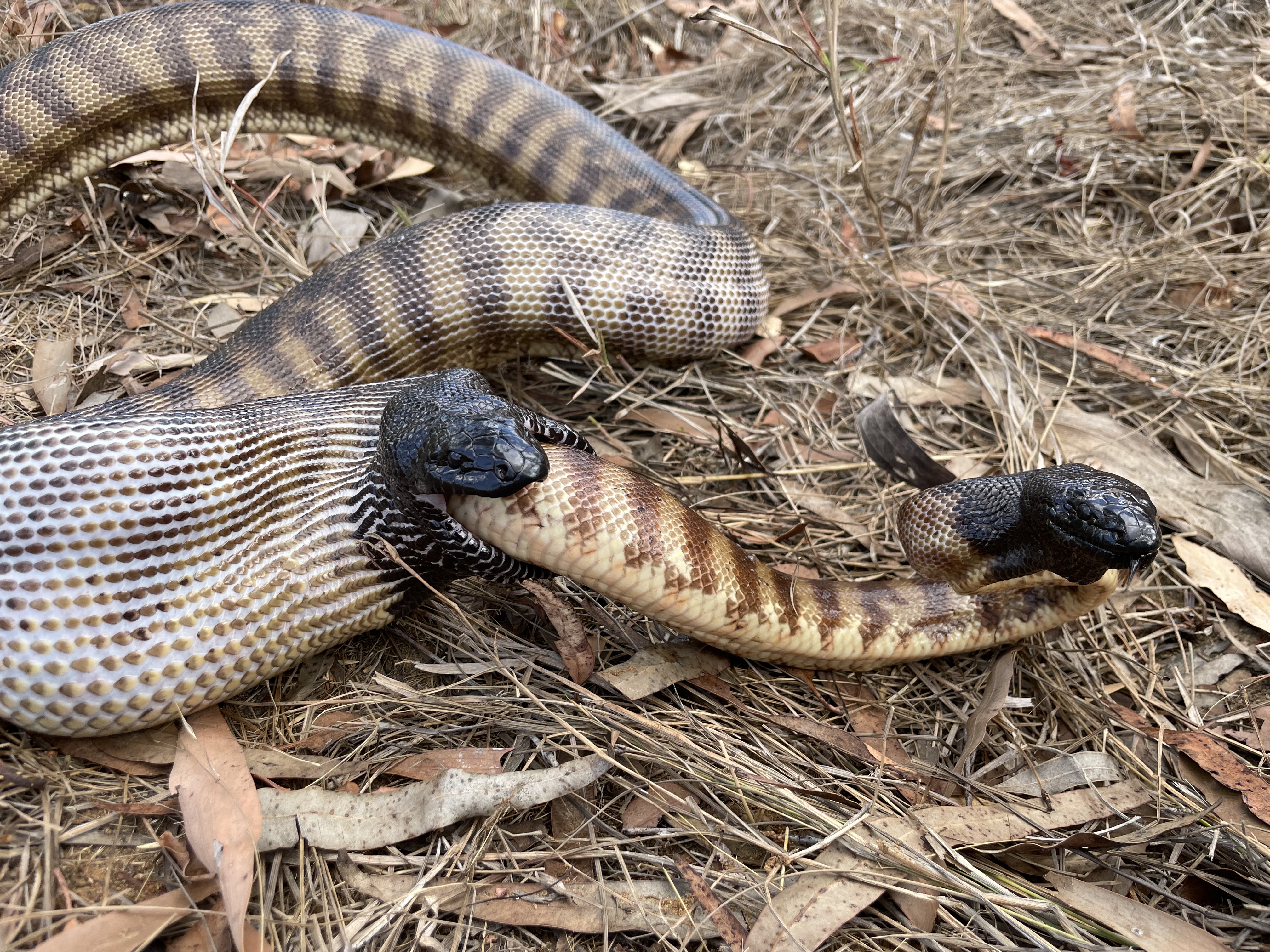
Snakes in several families are known to partake in maternal cannibalism, which often plays out with the mother consuming some of her own eggs. Entiauspe-Neto says it’s hard to know why they do this, but there could be a couple of reasons. Mothers could be weeding out the bad eggs, especially if they consume eggs selectively. This could be to mitigate disease or reduce the possibility that the smell of dead, rotting eggs could attract predators that would eat the viable eggs, too. “Eating those nonviable offspring could protect the viable offspring,” he says. “We found a high proportion of [boa family] snakes doing that, which are usually the ones that exhibit maternal care.” Or it could be that the mother gains some energy from eating a few eggs—she may just be hungry.
Cannibalism might take other forms between snakes and their kin. “Siblings may prey on each other to reduce competition,” Entiauspe-Neto says, though most of these records were observed in captivity.
That setting could create a bias in the study’s findings. Forty-three percent of cannibalism reports were about snakes in captivity, while the contexts of nearly a third were undetermined. “That dominated a lot of their results; most of them were in these captive settings,” says Jones. Just the same, he describes the review as “comprehensive.”
Falcão adds that some of the older reports, from the late 19th century through the mid-20th century, were dubious ecologically and ethically, dating from a different era in research. Scientists back then would sometimes starve captive snakes to see whether they would cannibalize each other eventually. Or they would put two snakes together with one prey item—she saw a report of one snake swallowing another by accident as they both tried to ingest the same prey in something like the horror story version of Lady and the Tramp sharing a noodle. “There were no laws; people weren’t talking about animal rights,” Falcão says.
These practices raise questions about whether some of the species would be cannibalistic under natural conditions. A majority of the reports regarding vipers—the most cannibalistic snake group in the Americas, according to the study—were in captivity. And the authors suggest that most of the viper cannibalism was due to captivity-related stresses.
Harvey Lillywhite, a retired ecologist at the University of Florida, who wasn’t involved in the research, describes the study as “comprehensive, well executed and generally well written.”
He hesitates to call cannibalism an evolved trait, though. “It seems to be an opportunistic and plastic behavior that arises in multiple circumstances rather than a genetically ‘fixed’ character,” he says.
Regardless, Falcão says this study is likely just the tip of the iceberg for cannibalism in snakes. “We’re very aware that this number is still an underestimate,” she says. “There are likely many ‘hidden’ records in older books, unpublished reports and museum archives, as well as observations from remote regions that are rarely documented in the scientific literature.”

Advertisement - Continue Reading Below
Latest


/https://tf-cmsv2-smithsonianmag-media.s3.amazonaws.com/filer_public/da/84/da84f5cf-88e0-4e84-9d81-2655722afd74/ezgif-297fe9dc976fb678.jpg?ssl=1 "Strange, Shovel-Tusked Elephants Puzzled Paleontologists, Until Experts Took a Closer Look at Their Teeth")


Advertisement - Continue Reading Below